
How does time travel work
A beginner’s guide to time travel
Learn exactly how Einstein’s theory of relativity works, and discover how there’s nothing in science that says time travel is impossible.
Einstein found that the faster you move through space, the slower you move through time — you age more slowly, in other words. One of the key ideas in relativity is that nothing can travel faster than the speed of light (opens in new tab) — about 186,000 miles per second (300,000 kilometers per second), or one light-year per year). But you can get very close to it. If a spaceship were to fly at 99% of the speed of light, you’d see it travel a light-year of distance in just over a year of time.
That’s obvious enough, but now comes the weird part. For astronauts onboard that spaceship, the journey would take a mere seven weeks. It’s a consequence of relativity called time dilation, and in effect, it means the astronauts have jumped about 10 months into the future.
The satellites have to compensate for time dilation effects due both to their higher altitude and their faster speed. So whenever you use the GPS feature on your smartphone or your car’s satnav, there’s a tiny element of time travel involved. You and the satellites are traveling into the future at very slightly different rates.

Trajectories in space-time that loop back into the past are given the technical name «closed timelike curves.» If you search through serious academic journals, you’ll find plenty of references to them — far more than you’ll find to «time travel.» But in effect, that’s exactly what closed timelike curves are all about — time travel
This article is brought to you by How It Works.
How It Works is the action-packed magazine that’s bursting with exciting information about the latest advances in science and technology, featuring everything you need to know about how the world around you — and the universe — works.
There’s another way to produce a closed timelike curve that doesn’t involve anything quite so exotic as a black hole or wormhole: You just need a simple rotating cylinder made of super-dense material. This so-called Tipler cylinder is the closest that real-world physics can get to an actual, genuine time machine. But it will likely never be built in the real world, so like a wormhole, it’s more of an academic curiosity than a viable engineering design.
Yet as far-fetched as these things are in practical terms, there’s no fundamental scientific reason — that we currently know of — that says they are impossible. That’s a thought-provoking situation, because as the physicist Michio Kaku is fond of saying, «Everything not forbidden is compulsory» (borrowed from T.H. White’s novel, «The Once And Future King»). He doesn’t mean time travel has to happen everywhere all the time, but Kaku is suggesting that the universe is so vast it ought to happen somewhere at least occasionally. Maybe some super-advanced civilization in another galaxy knows how to build a working time machine, or perhaps closed timelike curves can even occur naturally under certain rare conditions.
A party for time travelers
Hawking was skeptical about the feasibility of time travel into the past, not because he had disproved it, but because he was bothered by the logical paradoxes it created. In his chronology protection conjecture, he surmised that physicists would eventually discover a flaw in the theory of closed timelike curves that made them impossible.
In 2009, he came up with an amusing way to test this conjecture. Hawking held a champagne party (shown in his Discovery Channel program), but he only advertised it after it had happened. His reasoning was that, if time machines eventually become practical, someone in the future might read about the party and travel back to attend it. But no one did — Hawking sat through the whole evening on his own. This doesn’t prove time travel is impossible, but it does suggest that it never becomes a commonplace occurrence here on Earth.
The arrow of time
It turns out that entropy is the only thing that makes a distinction between past and future. In other branches of physics, like relativity or quantum theory, time doesn’t have a preferred direction. No one knows where time’s arrow comes from. It may be that it only applies to large, complex systems, in which case subatomic particles may not experience the arrow of time.
Time travel paradox
If it’s possible to travel back into the past — even theoretically — it raises a number of brain-twisting paradoxes — such as the grandfather paradox — that even scientists and philosophers find extremely perplexing.
Killing Hitler
A time traveler might decide to go back and kill him in his infancy. If they succeeded, future history books wouldn’t even mention Hitler — so what motivation would the time traveler have for going back in time and killing him?
Killing your grandfather
Instead of killing a young Hitler, you might, by accident, kill one of your own ancestors when they were very young. But then you would never be born, so you couldn’t travel back in time to kill them, so you would be born after all, and so on …
A closed loop
Suppose the plans for a time machine suddenly appear from thin air on your desk. You spend a few days building it, then use it to send the plans back to your earlier self. But where did those plans originate? Nowhere — they are just looping round and round in time.
How Time Travel Works
From millennium-skipping Victorians to phone booth-hopping time traveler teenagers, the term time travel often summons our most fantastic visions of what it means to move through the fourth dimension. But of course you don’t need a time machine or a fancy wormhole to jaunt through the years.
We measure the passage of time in seconds, minutes, hours and years, but this doesn’t mean time flows at a constant rate. In fact Einstein’s theory of relativity determines that time is not universal. Just as the water in a river rushes or slows depending on the size of the channel, time flows at different rates in different places. In other words, time is relative.
But what causes this fluctuation along our one-way trek from the cradle to the grave? It all comes down to the relationship between time and space. Human beings frolic about in the three spatial dimensions of length, width and depth. Time joins the party as that most crucial fourth dimension. Time can’t exist without space, and space can’t exist without time. The two exist as one: the space time continuum. Any event that occurs in the universe has to involve both space and time.
In this article, we’ll look at the real-life, everyday methods of time travel in our universe, as well as some of the more far-fetched methods of dancing through the fourth dimension.
Did you know your GPS devices rely on time-travel calculations to help you navigate around town? It’s true! GPS satellite clocks are about 38 seconds longer per day than a clock closer to earth due to the gravitational frequency shift. They make up for this discrepancy by using time travel calculations or they could be way off from your current location and time.
Is Time Travel Possible?
We all travel in time! We travel one year in time between birthdays, for example. And we are all traveling in time at approximately the same speed: 1 second per second.

We typically experience time at one second per second. Credit: NASA/JPL-Caltech
NASA’s space telescopes also give us a way to look back in time. Telescopes help us see stars and galaxies that are very far away. It takes a long time for the light from faraway galaxies to reach us. So, when we look into the sky with a telescope, we are seeing what those stars and galaxies looked like a very long time ago.
However, when we think of the phrase «time travel,» we are usually thinking of traveling faster than 1 second per second. That kind of time travel sounds like something you’d only see in movies or science fiction books. Could it be real? Science says yes!
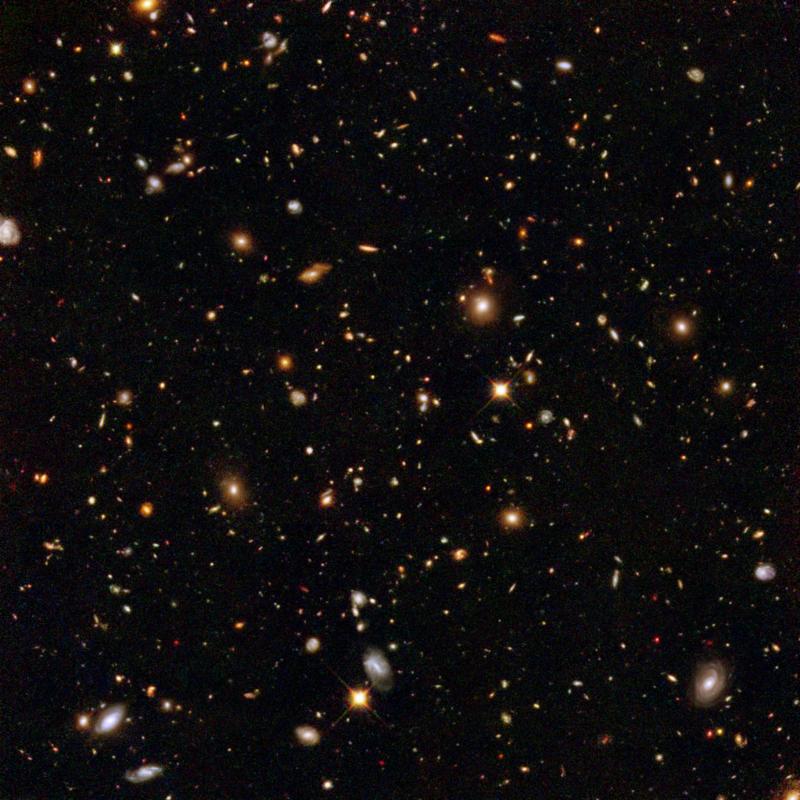
This image from the Hubble Space Telescope shows galaxies that are very far away as they existed a very long time ago. Credit: NASA, ESA and R. Thompson (Univ. Arizona)
How do we know that time travel is possible?
More than 100 years ago, a famous scientist named Albert Einstein came up with an idea about how time works. He called it relativity. This theory says that time and space are linked together. Einstein also said our universe has a speed limit: nothing can travel faster than the speed of light (186,000 miles per second).

Einstein’s theory of relativity says that space and time are linked together. Credit: NASA/JPL-Caltech
What does this mean for time travel? Well, according to this theory, the faster you travel, the slower you experience time. Scientists have done some experiments to show that this is true.
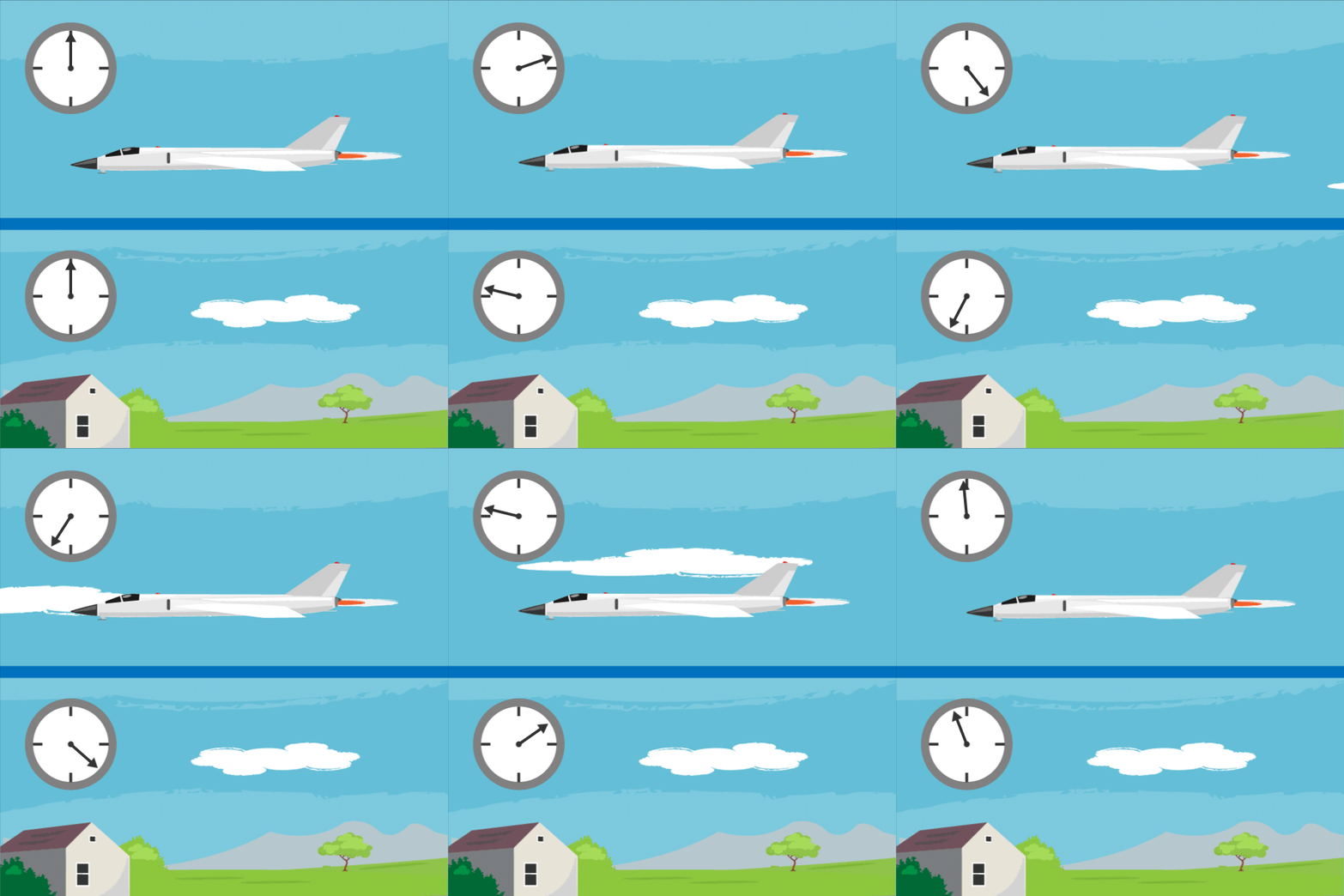
For example, there was an experiment that used two clocks set to the exact same time. One clock stayed on Earth, while the other flew in an airplane (going in the same direction Earth rotates).
After the airplane flew around the world, scientists compared the two clocks. The clock on the fast-moving airplane was slightly behind the clock on the ground. So, the clock on the airplane was traveling slightly slower in time than 1 second per second.
Can we use time travel in everyday life?
We can’t use a time machine to travel hundreds of years into the past or future. That kind of time travel only happens in books and movies. But the math of time travel does affect the things we use every day.
For example, we use GPS satellites to help us figure out how to get to new places. (Check out our video about how GPS satellites work.) NASA scientists also use a high-accuracy version of GPS to keep track of where satellites are in space. But did you know that GPS relies on time-travel calculations to help you get around town?
GPS satellites orbit around Earth very quickly at about 8,700 miles (14,000 kilometers) per hour. This slows down GPS satellite clocks by a small fraction of a second (similar to the airplane example above).
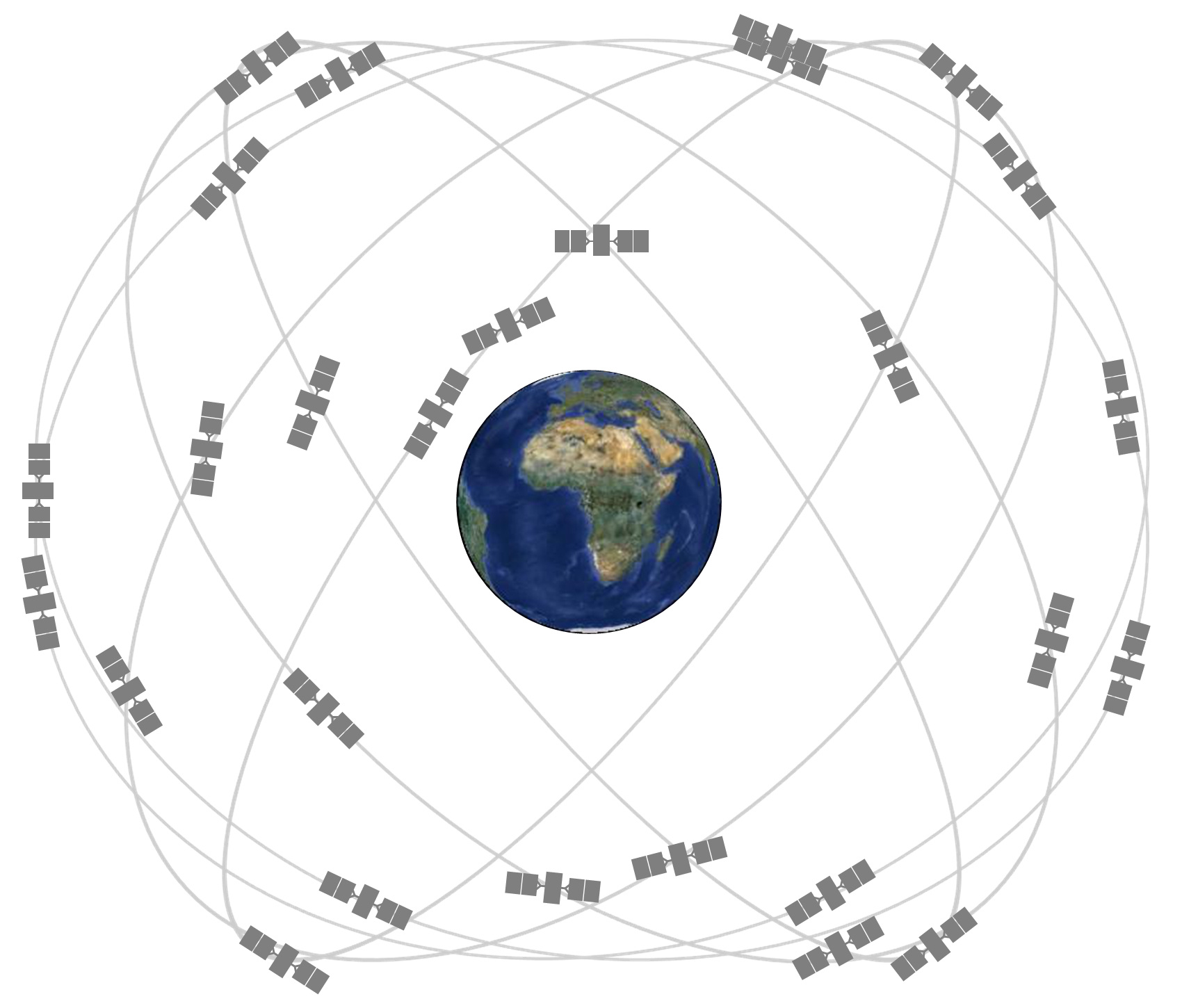
GPS satellites orbit around Earth at about 8,700 miles (14,000 kilometers) per hour. Credit: GPS.gov
However, the satellites are also orbiting Earth about 12,550 miles (20,200 km) above the surface. This actually speeds up GPS satellite clocks by a slighter larger fraction of a second.
Here’s how: Einstein’s theory also says that gravity curves space and time, causing the passage of time to slow down. High up where the satellites orbit, Earth’s gravity is much weaker. This causes the clocks on GPS satellites to run faster than clocks on the ground.
The combined result is that the clocks on GPS satellites experience time at a rate slightly faster than 1 second per second. Luckily, scientists can use math to correct these differences in time.

If scientists didn’t correct the GPS clocks, there would be big problems. GPS satellites wouldn’t be able to correctly calculate their position or yours. The errors would add up to a few miles each day, which is a big deal. GPS maps might think your home is nowhere near where it actually is!
In Summary:
Yes, time travel is indeed a real thing. But it’s not quite what you’ve probably seen in the movies. Under certain conditions, it is possible to experience time passing at a different rate than 1 second per second. And there are important reasons why we need to understand this real-world form of time travel.
How does time travel work
Time Travel; it’s something we all wish we could do so we could go back and fix something. However, we sadly cannot do this because time travel doesn’t exist, right? Well, so far as we know, there is no such thing as time travel outside of science fiction currently. Yet this might not actually be true. In fact, there are several things science now knows and has proven to be fact, all of which proves we might be able to do it. Of course, we want to make sure you understand that some of the things needed for it to happen can be considered quite complicated.
Meanwhile, other stuff is incredibly easy and very well could have already happened. However, we will explain a lot of this to you as well as major discoveries science has made that could affect time travel. First, we need you to be aware of a few other things too. This article will use a lot of theoretical concepts. The reason for this is that time travel itself is theoretical and therefore, anything we say that relates to it will be too. Even if those concepts are scientific facts, they will still be a victim to the theoretical territory because of their connection to the subject. We also want you to be aware that our goal for this article is to inform, but you will not walk away learning how to build a time machine. In fact, this is one of the things we will touch on soon. Without further delay, let’s get started.
 [Image via Oleg Golovnev/Shutterstock.com]
Albert Einstein’s Theory Of Relativity
We should mention that a lot of the stuff we discuss to start off this article will be based around the Theory of Relativity proposed by Albert Einstein decades ago. Technically, Einstein’s ideas are no longer a theory but rather, a fact. Why are his concepts on relativity so important? Beyond the infamous E=MC2 equation, the Theory of Relativity connects both Special Relativity and General Relativity.
 [Image via Newsroom.ucla.edu] Both are important but they are what helps us determine how gravity and time are connected. Gravity itself was technically discovered and analyzed by Isaac Newton. However, he could not figure out how gravity operated instantaneously at a distance. Einstein helped us see gravity as a force that moved matter along the shortest space, all within a curved spacetime. He found that the Sun bends spacetime and tells planets how to move.
Newton could not know time and space were not technically fixed. Einstein could and when he figured it all out with his relativity concepts, he infamously wrote “Newton, forgive me.” This was to signify that he found that Isaac could not, as he ruined Newton’s theory with his own. Einstein’s discoveries led to Quantum Physics we use today. Albert also discovered the Cosmological Constant and Unified Field Theories. Both are also useful when discussing time travel.
 [Image via Forance/Shutterstock.com]
Spacetime
It is very important that you keep in mind that when discussing time travel, often spacetime will come up. The reason for this is that it connects to several different areas of how time itself passes. For example, GPS systems are not connected technically to on-ground sources. They connect to satellites in low-orbit. They’re roughly 12,500 miles above the Earth’s surface.
 [Image via Livescience] Due to being outside of the Earth and rotating around with it, one would assume that time-wise they are connected to the same time as our own. However, they’re actually off by 1 second per second. Since Albert Einstein was able to accurately find that gravity actually curves space and time, scientists knew how to calculate for this time difference.
Since gravity is weaker in low-orbit, time is altered. In this area, they even run faster in time. Yet Spacetime overall is important to keep in mind. Gravity dictates how spacetime operates, in that, the more gravity something has, the slower time will pass.
 [Image via Agsandrew/Shutterstock.com]
Gravitational Time Dilation
Gravitational Time Dilation is present to help us make assumptions about how time will pass for us. Meaning, if we did visit a new planet with different forms of gravity to our own, we can make an accurate assumption of how this gravity will impact our species. Einstein came up with this under his Special Relativity concept.
 [Image via Calculators.io] Gravitational Time Dilation is essentially a comparison model where we bring in two things or events and give them different forms of gravity. The time dilation will be how the time is altered between the two. Einstein found that when the potential for gravity lowers, time will pass slower. However, as gravity increases, the faster the time will be.
In fact, we were even able to find that the Earth’s core is roughly 2.5 years younger than its surface due to this model. This proved to us that larger effects will require a bigger distance or a larger source of gravity.
 [Image via Britannica]
NASA Twins
How space & gravity affected humans intrigued NASA, so they wanted to do a comparison experiment with twins. Therefore, they used Mark & Scott Kelly. They were perfect because they’re identical and did not have any major differences. In fact, both men were checked for everything known to man and seemed to match up in every major category pre-flight.
 [Image via Nasa] Scott went into space while Mark remained on Earth. The testing NASA wanted to do was immense. They wanted to test how the immune system responded as well as information on epigenetic changes, gut bacteria, body weight, serum metabolites, and much more.
Scott spent a year in space and upon returning, he showed positive numbers that gave scientists a lot of hope when it comes to possible long-term space travel. Some numbers were even considered shocking. However, compared to his brother Mark, Scott was a bit taller, had less facial aging, and much more. If you want to read a full summary of the study, click here.
 [Image via Pixelparticle/Shutterstock.com]
Speed Of Light & Lightyears
While it might not seem to be hard to comprehend the speed of light is fast, we need you to grasp how fast it actually is. In terms of speed, the number of miles that light travels per second are 182,282. In terms of kilometers per second, that translates to 299,792. Yet in MPH terms, or how we normally judge speed, one could travel 670,616,629 miles in a given hour.
 [Image via History] Nothing can quite move this quickly other than the light itself. If we were able to capture the ability to do this in a machine…it could be the secret to long-term space travel and even teleportation. This is also key when understanding how lightyears operate too. When you hear that a planet is roughly 10 lightyears away, this does not mean it takes 10 years to get to.
Rather, it would take 10 Earth Years to get there when moving at “the speed of light.” The fastest a manned vehicle has ever been able to go was done by the Apollo 10 when it moved at 24,791 MPH. At this rate, to get to something 10 lightyears away, it would take us 270,000 Earth Years!
 [Image via Denis Belitsky/Shutterstock.com]
Airplane Speed & Time Experiment
When something moves faster in terms of speed, the slower one will experience time. If you move fast, you will experience time along with the fast-moving manned craft you’re in. Meaning, you are going to age a bit differently compared to those who are not in the craft with you. Scientists used an airplane to confirm that idea.
 [Image via Wikipedia] An experiment was done using two clocks. One went up in the airplane while the other remained on the Earth’s surface. The fast-moving plane went up in the air and flew around the world in the direction that the Earth rotates. This meant it ideally would be going with the same movement of time that a clock would be going.
Once the plane landed, scientists found the clock on the airplane was a bit behind the ground clock. Yet both clocks were set to exactly the same times before the experiment began. They found that the airplane clock moved roughly 1 second per second slower than the ground clock. This proved the time on the clock was affected by the speed of the plane it was in.
 [Image via Dean Drobot/Shutterstock.com]
Why This Is Important
While understanding spacetime and gravity might seem useful, it’s likely you want to know what they have to do with time travel. This is a good thing to question but the answer is simple. Both help us how to determine the operation of time and how we travel in it.
 [Image via Abccolumbia] Basically, if you do not know how gravity changes time then it’s hard to know how time travel itself actually works. In fact, it is due to this knowledge on time and gravity that time travel is even possible at all for a human being to do in a major form. Yet lightspeed and lightyear knowledge helps when understanding that speed and time are also connected.
This was proven in the Airplane experiment and many others over the years. Due to Einstein and his Theory of Relativity, which includes quite a lot honestly, we know mankind can do a lot more than once assumed. Basically, we said all of this so you’ll understand that time travel has been technically possible for a long time.
 [Image via John David Bigl III/Shutterstock.com]
Could Time Travel Be Fatal To Humans?
It’s hard to know how time travel might affect humans if we indeed did manage to do it in the science fiction way. We know it would take incredibly high speeds and the problem with something like this is the force it causes. For example, on a cruise ship, you often expect to go to the front of the ship and do what you see on the Titanic film. However, what actually happens is that in spite of the ship going no faster than the average speed limit of your car.
 [Image via lassedesignen/Shutterstock] It brings in a ton of force and you can barely walk around, much less have Leonardo DiCaprio hold you with only a small bit of hair movement. This force is minuet compared to the speed of light. In fact, you can go to The Space and Rocket Center in Huntsville, Alabama to experience their G-Force machine that spins around at high speeds. It is used to simulate the force astronauts feel during liftoff.
Removing gravity in space would result in a lack of most G-Forces, which is good. However, even if we removed gravity, the speed of light will need acceleration which still causes G-Forces in space. The fact that we’ve never reached it with a manned vehicle proves we need better technology otherwise man could never survive possible major time travel. This would ideally need higher speeds to accomplish.
 [Image via Universal Pictures]
Time Travel Can Only Be Done Into The Future…For Now
A lot of the time when we think of time travel, we speak about how we’d go back in time. However, this is not exactly an easy thing to do. The reason for this is mostly down to the fact that we are unable to physically go back to change what already happened. However, we can shape our futures and therefore travel into the future possibly hundreds to thousands of Earth years.
 [Image via Wallpaperaccess] An Earth Year is nowhere near the same as a year in spacetime nor can it be compared to a year on a distant planet. If one spends what they believe is an Earth Year physically traveling through space and comes back to Earth…we already know timewise things may not add up. However, depending on how far and fast they are traveling…they could very well hop into the future several Earth years ahead. Yet they won’t physically experience the change.
They’ll come back after spending just a year away to see Earth hundreds to thousands of years later. They will not have changed but generations of their family line would have already passed. Yet right now, this concept is only available when using spacetime and cannot be experienced on a planet. You could not gain the speed necessary and you’d need to deal with gravitational laws that spacetime won’t have as much of a problem with, at least outside of G-Forces.
 [Image via Appledesign/Shutterstock.com]
Time Travel In Spacetime Creates A Lot Of Problems
Let’s pretend we’re able to make a manned vehicle that can travel at the speed of light. Testing this would be hard to do but just for the fun of it, let’s say we found a way to do it. Now you’re capable of traveling distances we never thought we could ever reach, all in a short time period. However, here’s the rub of that. The short trip will be your experience but not Earth’s.
 [Image via Medium] Communicating with you might be impossible. At least for Earth, we can send a message in terms of light but if you’re a lightyear away it would take 1 year to get a light-made message. Yet Earth Years in total are not being considered here. Even though you’d make roughly a 2 lightyear roundtrip…you’d only age 2 years in spacetime.
Yet the Earth you return to could be thousands of years older than when you left it. What people forget is that the people on board the space shuttle would not experience Earth Year time but Earth will still age. When you discuss time travel, the only possible way to do it is truly to go into the future like this. Well, it used to be the only way.
 [Image via Matva/Shutterstock.com]
Backward Dimension
Scientists recently discovered what appears to be a dimension that is not moving forward but rather, moving backward. We basically mean that in its aging process, it’s only getting younger and not older. This possibly means that their time only will move backward but could never move forward.
 [Image via Tricycle] This dimension is a mirrored parallel universe scientists were shocked to discover. This is a pretty essential discovery because a mirror dimension to our own could play a role in time travel. Currently, we can only move forward in time while their universe could only move backward. However, being a mirrored universe, everything means the opposite.
Therefore, it is a universe where left is right & up is down. On top of this, you have to look at the implications of such a place. If it is completely mirrored, that also means the people are mirror images. However, if everything is backward to us, does that mean the people and their lives are also backward? Does everyone have a Benjamin Button syndrome here? Is everything in true reverse? Honestly, we don’t know….but doesn’t that make it all the more intriguing?
 [Image via Liu zishan/Shutterstock.com]
What This Means
What does this mean to us when discussing time travel? It means that if a mirrored universe exists and we can access it, we could follow their laws when it comes to physics. If they can only move backward and we can only move forward, there is a good chance that accessing it would allow us to go backward in time.
 [Image via Interestingengineering] How can this be done? That’s the complicated part. There have been some who feel wormholes could be the best possible avenue, especially if we could create our own version that could be controlled. If this ever did happen, then connecting to a mirrored universe could be possible. However, this is the stuff of science fiction and not science fact as of yet. Theoretically though, if we could access this universe then we could possibly travel back in time.
As we could enter this wormhole then exit in space. This allows us to remove any possible gravitational issues. If we can control the wormhole, then we could open it to pop back into our own universe at the exact time we wish to go back to. Since our mirrored universe goes only backward, we’d follow their laws of physics to the letter this way. Yet if we did this, there’s a lot to consider.
 [Image via NeoLeo/Shutterstock.com]
Cosmic Strings
Sometimes, you do not need to consider traveling through space or even focus on lightyears and speed. Perhaps, all you need to consider for time travel to be possible is Cosmic Strings. It is believed that these strings are tubes of energy that stretch across the entire length of our expanding universe.
 [Image via Medium] This connects a lot of major concepts but time travel seems to be the most prominent here. Cosmic String fans believe this is possibly the best thing for time travel to be possible because these strings are leftover from the early cosmos. Since they likely contain huge amounts of mass, they could technically warp or fold spacetime around them.
It is assumed that Cosmic Strings are either infinite or they’re in never-ending loops. If two strings came close to one another, essentially parallel to the other, they’d bend spacetime so much and in such a particular way that time travel could be possible using them. Of course, this is just a theory for now as is a lot of String Theory concepts.
 [Image via The Walt Disney Company]
Timeline Theories
There are two sets of timeline theories to consider. The first is the one every science fiction movie and book seems to be based on. If you go back in time and do something, it could directly impact the time you go back to. Yet in other theories, this is not the case. Some believe that your past is constant, meaning it will never change.
 [Image via andrey_l/Shutterstock] Let’s pretend you went back in time and killed Baby Hitler like you might hear people mention. If you did this, some believe it will result in the future never having heard of Adolph Hitler. Yet in this “past is constant” theory, you will go back to your own time and never see a change. Hitler always existed. This is due to the fact that you have not affected your own timeline but rather, invented a new timeline that will create essentially its own new universe.
Others believe that your timeline will still always exist but you might go back to your own time to experience the change because you were absorbed into this new universe you basically created by killing Baby Hitler. Let’s explore this a bit more through effects and paradoxes.
 [Image via Agsandrew/Shutterstock.com]
The Butterfly Effect
No, we’re not going to be discussing the Ashton Kutcher movie of the same name. However, they were pretty spot on with what this theory suggests. The Butterfly Effect is part of what is known as “chaos theory.” This theory is made up of a branch of math focusing on dynamic systems where random states of disorder and/or irregularities are often governed by deterministic laws that are sensitive to initial conditions. Basically, there are underlying patterns in randomness.
 [Image via Forbes] The Butterfly Effect comes originally from the work of Edward Lorenz. He came up with this concept revolving around tornado and how it is influenced by minor things. In this case, the flapping of the wings of a distant butterfly and how it could have caused the tornado weeks later. Lorenz based this concept on following weather models and how weather itself can be altered over minor changes in the environment.
This was already something that French Mathematician Henri Poincaré and American Mathematician & Philosopher Norbert Wiener. Lorenz’s theory was then used in the area of time travel by pointing to how little changes in the past could cause bigger changes down the line. Of course, this would be big to keep in mind if we indeed did affect our own universe when going back in time. As we could cause bigger problems than the type we might have stopped.
 [Image via Fizkes/Shutterstock.com]
Grandfather Paradox
This is the one that has quickly become the most debated in time travel paradoxes. Called the Grandfather Paradox, one person might feel that they want to die. Perhaps they don’t though but they feel that their family was part of a lot of bad things throughout history.
 [Image via Infinityexplorers] They are willing to selflessly go back in time and kill their grandfather or great(x times you need) grandfather, all to ensure their family does not exist. This will sadly cause them to not exist either but by doing this, they run into a paradox. If they kill their grandfather, then technically they prevent themselves from ever existing.
Therefore, they could not have gone back in time to kill their grandfather. Basically, it means that it would be like they never went back in time at all. Now, another person could kill their grandfather as long as there was no family relation. However, they simply could not. Keep in mind that this paradox is not exclusive to grandparents but several changes one might make in the past when time traveling.
 [Image via Motortion Films/Shutterstock.com]
Botched Suicide Paradox
A lot like the Grandfather Paradox, a Botched Suicide Paradox works pretty much the same way. However, are some differences here too, especially when looking at the timeline theories. In this instance, a person perhaps is tired of living and wants to go back in time to kill themselves.
 [Image via Photographee.eu/Shutterstock] Apparently, they don’t have the nerve to kill themselves but could easily kill a baby that happens to be them from the past. It could be any younger version of them, however. This does not need to be a baby, technically. In any case, they go back in time but seem to fail every time they try to kill their past self. Why?
They cannot kill themselves, because they would not be alive to have done so. Yet they could cause possible damage, such as markings that they will experience. However, you too will experience them. Let’s say you shoot at your younger self but miss and shoot their arm. You could look at yourself and see a mark left by the bullet in your arm, as you were shot while you were younger by some strange man who looked a lot like you.
 [Image via Warner Bros. Pictures]
Bootstrap Paradox
The Bootstrap Paradox is thought to be the most respected theory in the connected timeline. Why? It follows all the rules of the constant past concept without breaking from those laws. Basically, in this paradox, you experienced something in the past that was always going to happen. It is part of a casual loop.
 [Image via Youtube] In this format, one event causes the second event. Yet it was the second event that was actually the cause of the first. A great example of this can be seen in DC Comics’ The Flash character. Reverse Flash goes back in time to kill young Barry Allen but fails, then the Reverse Flash decides to instead kill Barry’s mother.
Barry got himself out of the home but could not save his mother. By going back in time to save his mother, he’d never become The Flash. Therefore, he has to let his mother die to become the hero the world needs. If she never does, he does not become a forensic specialist for the CCPD the night of a Particle Accelerator Explosion, which gave him his powers. Yet if he’s never The Flash, he cannot run back in time to stop himself from being killed either. Which creates a loop of needed actions.
 [Image via Warner Bros. Pictures]
Multiverse Theory
It’s interesting that we bring up The Flash in this scenario of time travel. He actually does go back in time to stop Reverse Flash from killing his mother in the Flashpoint Paradox story-arc. This is a key part of DC Comics that causes a few rifts in the multi-universe itself and ends up causing a Crisis Event.
 [Image via Alwaysoriginalcontent] In any case, when Flash does this he technically creates a new timeline and universe where his mother exists yet he is not The Flash. A lot of things are the same but many things are not. Bruce Wayne is killed instead of his parents, causing his father Thomas to become Batman while his mother actually becomes this universe’s Joker.
Superman does not land in a field but rather, the center of Metropolis. Wonder Woman and Aquaman have an affair leading to the death of Mera, the Queen of Atlantis. Thus causing a war that will wipe out the planet. This must be changed, so Flash finds a way to recreate the conditions that gave him powers, nearly killing himself to do so. All to go back in time. Yet this does not stop changes from happening because it still causes a rift where a third universe or timeline comes about.
 [Image via MingzhePhoton/Shutterstock.com]
Likely Parallel Universe Concept
If we did go back in time, it is most likely that we would end up being connected to the laws of the second timeline theory we proposed. This is the timeline where the past is constant and cannot technically be changed. When it does change, it would then create another universe branched off on its own.
 [Image via manjik/Shutterstock] Basically, if we kill Baby Hitler then we will not see the result of this in the timeline we return to. Hitler always existed in our timeline and always will. However, the interesting notion is to consider how we could end up remaining in this Hitlerless universe. One would conclude the only way to do this is to remain in the timeline we’ve gone back to.
Therefore, the changes you make would branch off a different timeline and you’d remain in it. However, you might not have to remain behind. It is interesting to note that if we did use the mirrored parallel universe to go back in time, to begin with, we’d likely be able to visit this new universe we created eventually. If we can access one universe, what stops us from accessing another? We just shouldn’t assume our time travel changes will affect our present timeline.
How does time travel actually work in Doctor Who?
You can’t rewrite history! (Except when you can.)

«Let me get this straight. a thing that looks like a police box, standing in a junkyard, it can move anywhere in time and space?»
«But that’s ridiculous!»
Time travel has been at the heart(s) of Doctor Who since the series’ very beginnings. But the show’s approach to exactly how it works, and what the rules of changing history are, has changed more times than the Doctor’s face.
Ten years into the show’s run, it was established that the Time Lords have their own Laws of Time, practically all of which the Doctor has broken over the course of his/her adventures: they include a strict policy of non-interference in the history of others, and a rule banning Time Lords from ever crossing over into their own time-stream (i.e. meeting their past self).
But those are all just self-imposed edicts. What are the fundamental rules of time travel, as far as Doctor Who is concerned? And do they make any sense? Let’s find out.
«You can’t rewrite history!»
In one of Doctor Who‘s very earliest jaunts into history, 1964’s ‘The Aztecs’, the first Doctor (William Hartnell) reprimands his companion Barbara (Jacqueline Hill) for planning to intervene in the Aztecs’ practice of human sacrifice. «You can’t rewrite history!» he insists. «Not one line!»
His words here are, of course, open to interpretation. When the Doctor says Barbara «can’t» rewrite history, he could either be saying that the act is physically impossible – that time travellers cannot impact events in a way that would change their future – or arguing that she simply shouldn’t interfere, because the results could be catastrophic.
Let’s be generous and assume that it’s the latter, because later Doctor Who makes it very clear that time can be rewritten. Well, sometimes.
The eleventh Doctor (Matt Smith) puts it in blunt terms in the 2010 episode ‘Flesh and Stone’: «Time can shift. Time can change. Time can be rewritten.»
Events in the past can be changed, and this will directly affect the future. ‘Pyramids of Mars’, a fourth Doctor’s outing (portrayed by Tom Baker) from 1975, provides us with a clear illustration of this, with companion Sarah Jane (Elisabeth Sladen) briefly returning to a version of 1980 that’s been transformed into an apocalyptic wasteland by the time tinkerings of villain Sutekh in 1911.